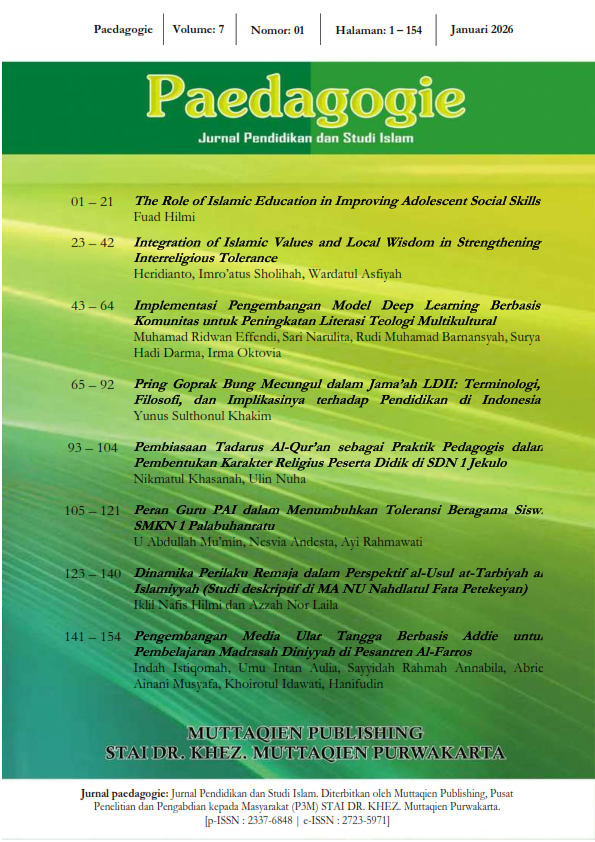
Dinamika Perilaku Remaja dalam Perspektif al-Usul at-Tarbiyah al-Islamiyyah
Studi deskriptif di MA NU Nahdlatul Fata Petekeyan
Keywords:
Ahmad Fu'ad Al-Ahwani, al-Usul at-Tarbiyah al-Islamiyyah, Character Building, Islamic Education, Moral Decadence of AdolescentsAbstract
This study discusses the increasingly alarming issue of moral decadence among adolescents, triggered by technological developments and a lack of strong moral guidance in Islamic educational institutions. The purpose of this study is to describe the concept of moral formation from the perspective of al-Uṣūl al-Islāmiyyah by Ahmad Fu'ad al-Ahwānī and its implementation at MA NU Nahdlatul Fata Petekeyan. The method used is a descriptive approach. -Tarbiyah al-Islāmiyyah by Ahmad Fu'ad al-Ahwānī and its implementation at MA NU Nahdlatul Fata Petekeyan. The method used is a qualitative descriptive approach, supported by a quantitative survey, to obtain an empirical picture of the application of Islamic educational values in shaping student character. Al-Ahwānī's theory emphasizes the three main pillars of Islamic education, namely tauhid, akhlak, and amal as a unity that shapes pious individuals. The results of this study show that these values are instilled through the formation of habits, teacher role models, and religious activities in madrasas, which foster students' spiritual, moral, and social awareness. The conclusion of this study confirms that the concept of al-Uṣūl at-Tarbiyah al-Islāmiyyah is relevant and can be applied as a solution to the decline in youth morals, as it helps create a balance between faith, knowledge, and deeds in the Islamic education system.
References
Handayani, B., Ranuwijaya, H. U., & Jumhana, N. (2022). Nilai-Nilai Pendidikan Akhlak Remaja Dalam Qur’an Surat Yusuf Dan Implementasinya Pada Pembelajaran Akidah Akhlak Di Mts Negeri 1 Kota Serang. JPDSH Jurnal Pendidikan Dasar Dan Sosial Humaniora, 1(8), 1595–1610.
Hanifah, M., & Purbosari, P. P. (2022). Studi Literatur: Pengaruh Penerapan Model Pembelajaran Guided Inquiry (GI) terhadap Hasil Belajar Kognitif, Afektif, dan Psikomotor Siswa Sekolah Menengah pada Materi Biologi. BIODIK: Jurnal Ilmiah Pendidikan Biologi, 8(2), 38–46. https://doi.org/10.22437/bio.v8i2.14791
Hori, M., & Budianto, M. N. (2024). Implementasi Pembelajaran Akidah Akhlak dalam Membentuk Kepribadian Siswa di Madrasah Ibtida ’ iyah. Journal of Islamic Education and Pedagogy, 1–3.
Istante, L. (2023). Dekadensi Moral Bagi Generasi Muda. Student Research Journal, 1(1), 23.
Mansyuriadi, M. I. (2022). Membentuk Kepribadian Muslim Peserta Didik. Pendidikan Dan Dakwah, 4(1), 14–22.
Mansyuriadi, M. I. (2024). Upaya Guru Akidah Akhlak dalam Mengatasi Dekadensi Moral Siswa di MTs NW Lenek I. AL-KARIM: Journal of Islamic and Educational Research, 2(4), 283.
Pakpahan. (2020). Metodologi Penelitian Ilmiah. Yayasan Kita Menulis. In Suparyanto dan Rosad (2015 (Vol. 5, Issue 3).
Permady, D. A., Taufik, H. N., & Mardiana, D. (2023). Pendidikan Adab dalam Membentuk Akhlak Siswa: Studi di Madrasah Aliyah (MA) Bilingual Batu - Jawa Timur. Edukatif : Jurnal Ilmu Pendidikan, 5(6), 2258–2267.
Ramadona Wijaya, F., Alya Rahmi Lubis, F., Najib Sihab Siregar, M., & Ayu Fauziah Batubara, A. (2025). Sumber Data, Subjek Penelitian, dan Isu Terkait. Jurnal Edukatif, 3(2), 271–276.
Sholahudin, M. (2023). Strategi Guru Dalam Menanamkan Nilai-nilai Akhlak Siswa Di Madrasah Aliyah Nurul Ummah Sungai Duri Kalimantan Barat. FATAWA: Jurnal Pendidikan Agama Islam, 1, 37–51.
Trivaika, E., & Senubekti, M. A. (2022). Perancangan Aplikasi Pengelola Keuangan Pribadi Berbasis Android Erga. JURNAL NUANSA INFORMATIKA, 16(1), 33–40.
Waruwu, M., Pu`at, S. N., Utami, P. R., Yanti, E., & Rusydiana, M. (2025). Metode Penelitian Kuantitatif: Konsep, Jenis, Tahapan dan Kelebihan. Jurnal Ilmiah Profesi Pendidikan, 10(1), 917–932. https://doi.org/10.29303/jipp.v10i1.3057
Wildan, S., & Meliyana. (2023). Implementasi Pembelajaran Akidah Akhlak dalam Membentuk Karakter Spiritual di Madrasah Aliyah Nurul Ummah. Risalah : Jurnal Pendidikan Dan Studi Islam, 9(2), 782–791.
Yudistira, S., Andriya, M., & Afandi, M. (2025). Peran Guru Sebagai Murabbi Dalam Perspektif Islam. EDU-RILIGIA: Jurnal Ilmu Pendidikan Islam Dan Keagamaan, 9(1). https://doi.org/10.47006/er.v9i1.22528
Zanariyah, S. (2024). Teknik Observasi Yang Efektif Dan Efisien Pada KegiatanKuliah Kerja Nyata (KKN). Jurnal Pengabdian Multidisiplin, 4(3), 2024.
Published
How to Cite
Issue
Section
Copyright (c) 2026 Iklil Nafis Hilmi, Azzah Nor Laila

This work is licensed under a Creative Commons Attribution-ShareAlike 4.0 International License.
Copyright and Licensing Policy
Paedagogie: Jurnal Pendidikan dan Studi Islam allows authors to retain the copyright of their work and to retain publishing rights. By submitting and publishing with this journal, authors agree to the following terms:
-
Copyright remains with the author(s), and they grant the journal the right of first publication. The work is published under a Creative Commons Attribution-ShareAlike 4.0 International License (CC BY-SA 4.0), which permits use, distribution, and reproduction in any medium, provided the original work is properly cited and any derivative works are distributed under the same license.
-
Authors are allowed to enter into additional non-exclusive distribution agreements (e.g., posting to institutional repositories, publishing in books), with acknowledgment of the work's initial publication in this journal.
-
Authors are encouraged to disseminate their work online (e.g., in repositories or on personal websites) before and during the submission process to increase visibility and impact.
Paedagogie: Jurnal Pendidikan dan Studi Islam supports open access and affirms that libre access with a CC BY-SA license or its equivalent is the optimal approach for scholarly communication. We prioritize free and open dissemination while encouraging the reuse and adaptation of published content under fair and equitable terms.

You are free to:
- Share — copy and redistribute the material in any medium or format
- Adapt — remix, transform, and build upon the material for any purpose, even commercially.
- The licensor cannot revoke these freedoms as long as you follow the license terms.