Integration of Psychological Aspects and Islamic Values in Domestic Dispute Mediation in Religious Courts
Keywords:
Mediation, Psychological Aspects, Family Disputes, Interpersonal Communication, IslahAbstract
Mediation is a form of Alternative Dispute Resolution that aims to achieve amicable settlements between disputing parties. In the context of family disputes in Indonesia, mediation plays a strategic role in preventing divorce and maintaining family unity and harmony. However, the effectiveness of mediation is influenced not only by legal and procedural factors but also by the psychological conditions and dynamics of the parties involved. This study examines the role of psychological aspects in determining the success of family dispute mediation in the Religious Courts of Indonesia. Using an empirical legal research design with a qualitative sociological approach, primary data were collected through in-depth interviews with judges, mediators, and disputing parties at the Religious Court of Purwakarta, supported by direct observation of mediation sessions. The findings reveal that mediators who understand the psychological dynamics of the parties are more capable of creating a conducive mediation environment, managing emotions effectively, and facilitating constructive communication. Psychological aspects significantly contribute to the achievement of amicable agreements and to the sustainability of post-mediation relationships. Accordingly, the integration of psychological approaches into the training and practice of family mediation in the Religious Courts should be strengthened to enhance the effectiveness of family dispute resolution in a peaceful, humane, and just manner. This study aligns with the principles of Islamic law, particularly the concepts of islah (reconciliation) and shulh (amicable settlement), as well as the objectives of maqāṣid al-sharīʿah, especially hifz al-nasl (the protection of progeny and family integrity).References
Journal
Ala-Kortesmaa, S., Hakanen, S., & Kaivola, T. (2024). Listening in Court-Connected Mediations. Negotiation and Conflict Management Research.
An, J., Kim, H., & Lee, S. (2024). A Serial Mediating Effect of Perceived Family Support on Well-Being. Frontiers in Psycology.
Gussevi, S., Novianty, I., & Supiana, P. (2023). Father's Obligations for Post-Divorce Child Support Rights. Muttaqien: Indonesian Journal of Multidisciplinary Islamic Studies, 4(1), 29-46.
Gussevi, S., Rosadi, A., Saepullah, U., Muttaqin, T., & Alman, J. F. (2025). Religious Court of Purwakarta: Efforts to Increase the Effectiveness of Case Resolution and Minimize Social Impact. Muttaqien: Indonesian Journal of Multidiciplinary Islamic Studies, 6(2), 174-200. .
Hoe, S. W. (2025). Resolving Drama with a Trauma-Tranformed Approach in Family Mediation. In Handbook of Mediation (World Scientific).
Ismayawati, A., Aristoni, & Chaedar, S. M. (2024). Family Conflict Resolution Through Mediation in Indonesia and Malaysia: A Sociological Study of Islamic Law. Jurnal Hukum Islam, 22(2).
Lawyers, A. A. (2024). Trauma-Informed Mediation: A Path to Healing and Resolution. Journal of the American Academy of Matrimonial Lawyers, 37(1), 325-348.
Min, K.-S., Kim, S.-B., & Kim, H.-Y. (2021). Why does Active Listening Enhance Satisfaction? Journal of Retailing and Consumer Services.
Purwakarta, P. A. (2026). Recapitulation of Divorce Cases and Divorce Lawsuits in 2025. Purwakarta: Purwakarta Religious Court. Retrieved from: https://www.pa-purwakarta.go.id.
Rahmawati, N. (2022). The Role of Empathy in the Effectiveness of Family Mediation. Journal of Psychology and Law, 8(2), 79-90.
Scafuto, F., Andolfi, F., & Caputi, C. (2024). The Mediation Role of Emotion Regulation Strategies in Conflict Resolution. Current Psychology.
Sebyar, M. H. (2025). Divorce Mediation and Religious Court Mediation (2021-2022). Al-Manahij: Journal of Law and Social Institutions.
Statistics, B. P. (2025). Divorce Statistics in Indonesia in 2025. Jakarta: BPS RI.
Vahlevi, D. R. (2021). The Concept of Sulh and Tahkim as Alternatives in Efforts to Resolve Sharia Economic Disputes in the Modern Era. Darussalam Journal of Sharia Economics, IAIDA Press, 2(2), 81-91.
Wang, R., Li, Y., Zhang, Y., & Chen, W. (2023). Emotion Regulation as a Mediator of Adaptive Coping and Relationship Outcomes. Frontiers in Psycology.
Zaitullah, R. (2020). The Effectiveness of Mediation in Settlement of Divorce Cases in Religious Courts according to PERMA No. 1 of 2016. Al-Manhaj: Journal of Islamic Family Law, 2(2), 100-115.
Books
Afandi, D. (2020). Mediation as an Alternative to Dispute Resolution in Indonesia. Yogyakarta: Deepublish.
Cahyani, R. (2021). Psychology of Conflict in the Household. Jakarta: Rajawali Press.
Moleong, L. J. (2019). Qualitative Research Methodology (Revised Edition). Bandung: Remaja Rosdakarya.
Mukti, F., & Yulianto, B. (2020). Normative & Empirical Law Research Dualism. Yogyakarta: Student Library.
Raharjo, S. (2020). Restorative Justice in Divorce Case Mediation. Jakarta: Prenadamedia Group.
Rosadi, A. (2018). The Development of Islamic Courts in Indonesia. Bandung: Remaja Rosdakarya.
Salim, H. S., & Nurbani, E. S. (2013). Application of Legal Theory to Thesis and Dissertation Research. Jakarta: Rajawali Press.
Soekanto, S. (2006). Introduction to Legal Research. Jakarta: UI Press
Sugiyono. (2019). Qualitative, Quantitative and R&D Research Methods. Bandung: Alfabeta.
Zehr, H. (2018). The Little Book of Restorative Justive. New York: Good Books.
Interview
A. (2025, October Wednesday). The Plaintiff in the Divorce Case Sues at the Purwakarta Religious Court. (S. Gussevi, Interviewer)
Affandi, K. (2025, November Wednesday). Non-Judge Mediator of Religious Courts. (S. Gussevi, Interviewer)
B. (2025, October Wednesday). The Defendant in the Divorce Case Filed at the Purwakarta Religious Court. (S. Gussevi, Interviewer)
C. (2025, October Wednesday). Respondent in the Case of Talak Divorce at the Purwakarta Religious Court. (S. Gussevi, Interviewer)
D. (2025, October Wednesday). Applicant in the Case of Divorce Talak at the Purwakarta Religious Court. (S. Gussevi, Interviewer)
E. (2025, November Wednesday). The Defendant in the Divorce Case Filed at the Purwakarta Religious Court. (S. Gussevi, Interviewer)
F. (2025, November Wednesday). The Plaintiff in the Divorce Lawsuit at the Purwakarta Religious Court. (S. Gussevi, Interviewer)
Fakhrurazi. (2025, October Friday). Chairman of the Purwakarta Religious Court. (S. Gussevi, Interviewer)
Courtesy of you. (2025, October Friday). Judge of the Purwakarta Religious Court. (S. Gussevi, Interviewer)
Iskandar, A. (2025, November Wednesday). Clerk of the Purwakarta Religious Court. (S. Gussevi, Interviewer)
Muttaqin, T. (2025, November Friday). Non-Judge Mediator at the Purwakarta Religious Court. (S. Gussevi, Interviewer)
Syaf, N. A. (2025, October Friday). Judge of the Purwakarta Religious Court. (S. Gussevi, Interviewer)

Published
How to Cite
Issue
Section
Copyright (c) 2026 Sofia Gussevi, Encup Supriatna, Irfan Fahmi, Ujang Abidin, Maida Zahra

This work is licensed under a Creative Commons Attribution-ShareAlike 4.0 International License.
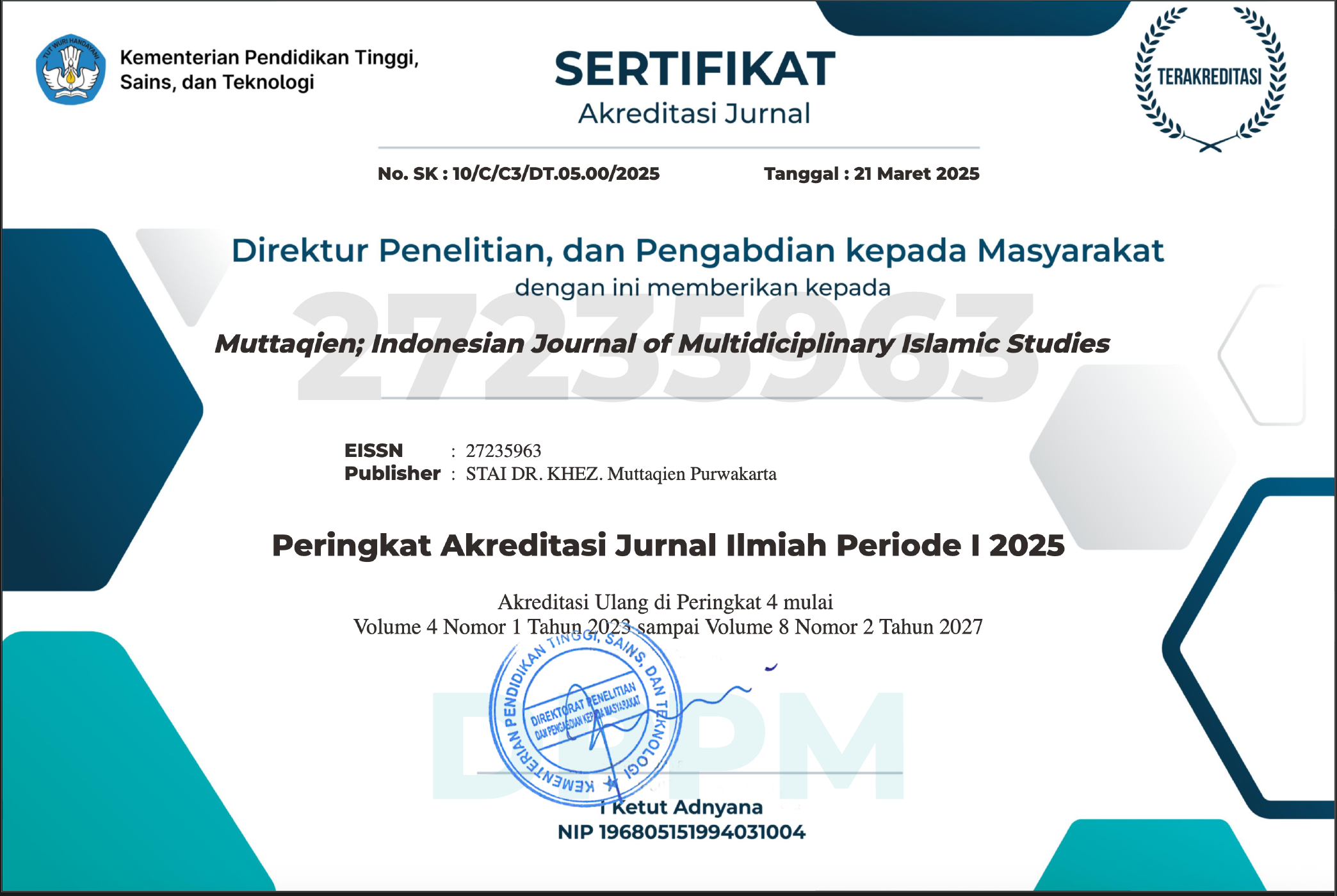
Muttaqien; Indonesian Journal of Multidiciplinary Islamic Studies allow the author(s) to hold the copyright without restrictions and allow the author(s) to retain publishing rights without restrictions and authors who publish with this journal agree to the following terms:
In developing strategy and setting priorities, Muttaqien; Indonesian Journal of Multidiciplinary Islamic Studies recognize that free access is better than priced access, libre access is better than free access, and libre under CC-BY-SA or the equivalent is better than libre under more restrictive open licenses. We should achieve what we can when we can. We should not delay achieving free in order to achieve libre, and we should not stop with free when we can achieve libre.
Muttaqien; Indonesian Journal of Multidiciplinary Islamic Studies has a CC-BY SA license or its equivalent as the optimal license for publication, distribution, use and reuse of scientific work. This license is under a Creative Commons Attribution 4.0 International License.

You are free to:
- Share — copy and redistribute the material in any medium or format
- Adapt — remix, transform, and build upon the material for any purpose, even commercially.
- The licensor cannot revoke these freedoms as long as you follow the license terms.