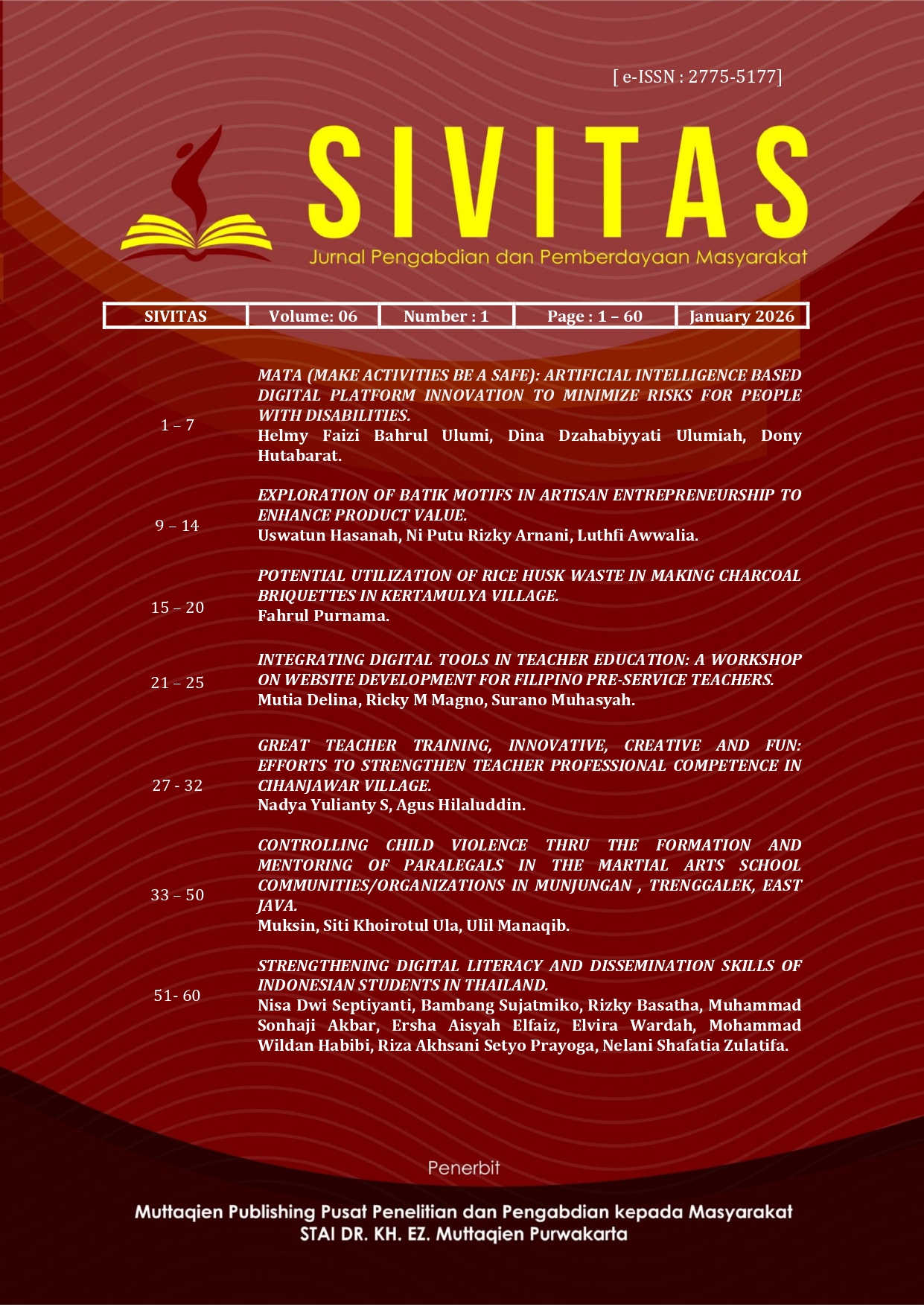
GREAT TEACHER TRAINING, INNOVATIVE, CREATIVE AND FUN: EFFORTS TO STRENGTHEN TEACHER PROFESSIONAL COMPETENCE IN CIHANJAWAR VILLAGE
Keywords:
great teacher, professional, innovative, creativeAbstract
A teacher is a personal figure who is a role model and role model for his students, because every word, action and behavior will become a highlight for his students. Teachers are also learning agents (learning agents) who act as facilitators, boosters, motivators, inspirers and learning engineers for students. An ideal teacher needs to have broad insight and knowledge both regarding their students and their learning strategies. Great Teacher, Innovative, Creative and Fun Training is training that provides insight and also soft skills to Teachers so that through this training they are able to increase Teachers' knowledge to become innovative, creative and fun Teachers, and improve Teachers' skills and professionalism in carrying out learning to students. This method of implementing Great, Innovative, Creative and Fun Teacher Training was carried out in Cihanjawar Village, Bojong District, Purwakarta Regency, given to 30 teachers from Cihanjawar Village which were packaged in the form of seminars and training conducted indoors. The results of the training showed that there was an increase in knowledge regarding teachers' professional abilities in implementing learning for students by 80%. Meanwhile, the practice of soft skills to become an innovative, creative and innovative teacher increased by 85%.
References
Erdogdu, M. Y. (2006). The adaptation of the creativity assessment scale to Turkish culture. Inonu University Egitim Fakultesi Dergisi, 7(12), 61–79.
Faizah, D. U. (2008). Keindahan belajar dan perspektif pedagogi. Jakarta: Cindy Grafika Hamdayama.
Hawadi, Reni Akbar. (2001). Kreativitas. Jakarta: PT Grasindo.
Ju, C. M. (2014). In celebration of creativity play: An exploration of children’s aesthetic sensibility and creativity in Waldorf early childhood education. Revista de Cercetare I Intervenție Socială, 47, 165–179.
Jumanta. (2014). Model dan metode pembelajaran kreatif dan berkarakter. Bogor: Ghalia Indonesia.
Kail, R. V. (2012). Children and their development (6th ed.). New Jersey: Pearson Education, Inc.
McLellan, R., Galton, M., Steward, S., & Page, C. (2012). The impact of creative partnerships on the well-being of children and young people. University of Cambridge: Creative Culture and Education.
Moleong, L. J. (2010). Metode penelitian kualitatif. Bandung: PT Remaja Rosdakarya.
Oren, M. (2009). Okuloncesinde yaraticiliğin gelistirilmesi. Dalam A. Ozturk (Ed.), Okuloncesinde yaraticilik ve drama egitimi (4th ed., Bab 3). Eskisehir: Anadolu University Publications.
Rahyubi, Heri. (2012). Teori-teori belajar dan aplikasi pembelajaran motorik. Bandung: Nusa Media Subroto.
Suryo. (2009). Proses belajar mengajar di sekolah. Jakarta: Asdi Mahastya.
Published
How to Cite
Issue
Section
Copyright (c) 2026 Nadya Yulianty S, Agus Hilaluddin

This work is licensed under a Creative Commons Attribution-ShareAlike 4.0 International License.
SIVITAS: Jurnal Pengabdian dan Pemberdayaan Masyarakat allow the author(s) to hold the copyright without restrictions and allow the author(s) to retain publishing rights without restrictions and authors who publish with this journal agree to the following terms:
In developing strategy and setting priorities, SIVITAS: Jurnal Pengabdian dan Pemberdayaan Masyarakat recognize that free access is better than priced access, libre access is better than free access, and libre under CC-BY-SA or the equivalent is better than libre under more restrictive open licenses. We should achieve what we can when we can. We should not delay achieving free in order to achieve libre, and we should not stop with free when we can achieve libre.
SIVITAS: Jurnal Pengabdian dan Pemberdayaan Masyarakat has a CC-BY SA license or its equivalent as the optimal license for publication, distribution, use and reuse of scientific work. This license is under a Creative Commons Attribution 4.0 International License.

You are free to:
- Share — copy and redistribute the material in any medium or format
- Adapt — remix, transform, and build upon the material for any purpose, even commercially.
- The licensor cannot revoke these freedoms as long as you follow the license terms.