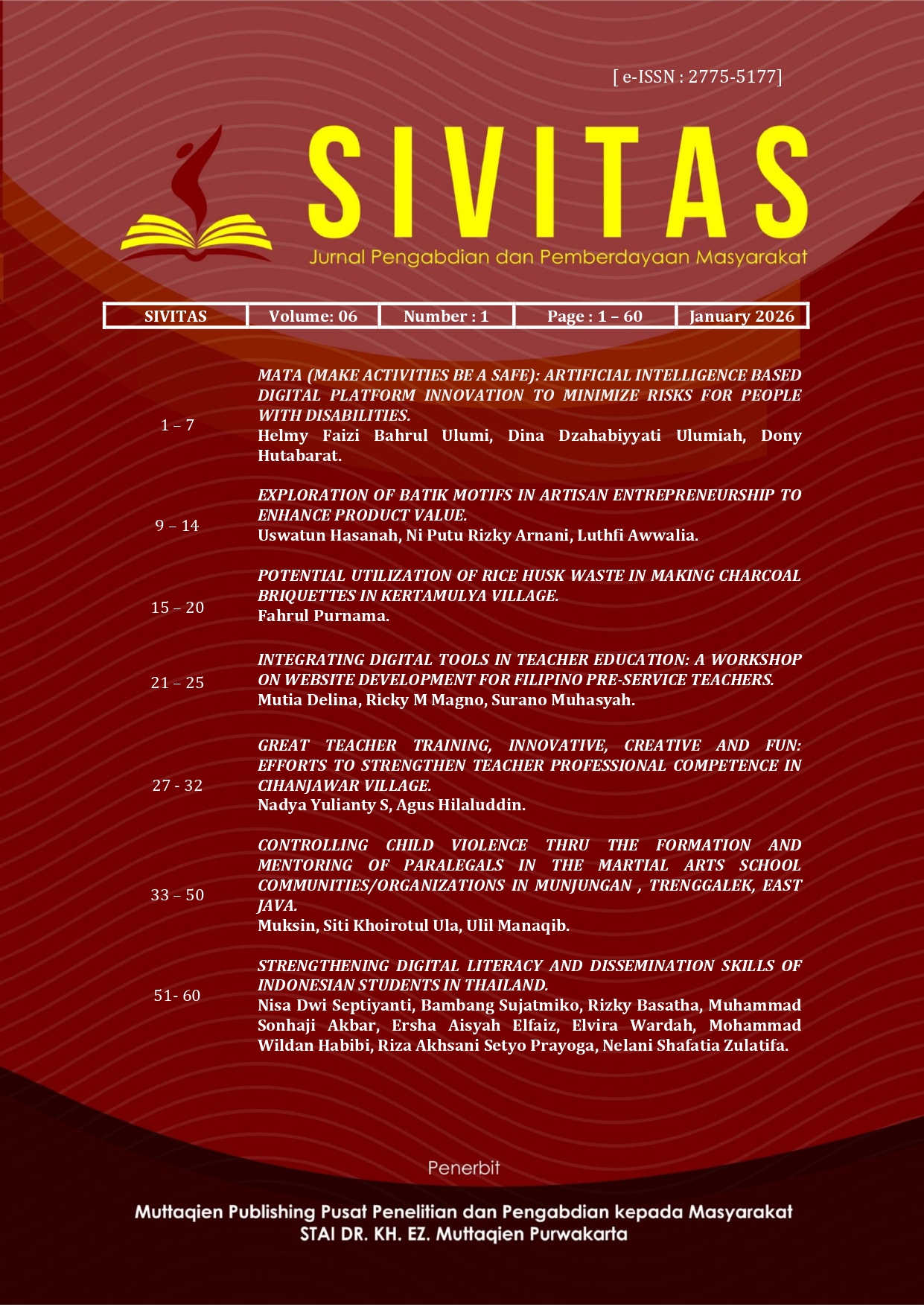
POTENTIAL UTILIZATION OF RICE HUSK WASTE IN MAKING CHARCOAL BRIQUETTES IN KERTAMULYA VILLAGE
Keywords:
rice husk, charcoal briquettes, alternative energy, sustainable environmentAbstract
Rice husk is an agricultural waste that is still underutilized, even though it has great potential as a raw material for making charcoal briquettes. This study aims to examine the potential for utilizing rice husk as charcoal briquettes and to educate the people of Kertamulya Village about the manufacturing techniques. The method used in this study is a descriptive method with a socialization approach and direct training to the local community. The briquette making process involves several stages, namely burning the husk using the pyrolysis method, mixing with natural adhesives, molding, and drying. The results of the experiment showed that the composition of the mixture of materials and the right drying method greatly affect the quality of the briquettes produced. Briquettes with a ratio of 100 grams of starch, 1 kg of charcoal powder, and 400 ml of hot water gave the best results with stable combustion and long-lasting embers. In addition to contributing to reducing agricultural waste, this innovation also has economic value by opening up business opportunities for the community. Therefore, the use of rice husk as charcoal briquettes can be an environmentally friendly and sustainable alternative solution in supporting energy security and the welfare of rural communities.
References
Dahdah, S. S. (2020). Pemanfaatan Sekam Padi Menjadi Briket Sebagai Energi Alternatif Studi Kasus Desa Wotansari – Balong Panggang. DedikasiMU(Journal of Community Service), 2(1), 180. https://doi.org/10.30587/dedikasimu.v2i1.1202
Mastuti, E. (2005). Pembuatan Asam Oksalat Dari Sekam Padi. Jurnal Ekuilibrium, 4(1), 13–17.
Padapi, A. (2022). Penyuluhan Optimalisasi Nilai Tambah Sekam Padi sebagai Briket Arang di Kabupaten Sidenreng Rappang, Sulawesi Selatan. MALLOMO: Journal of Community Service, 3(1), 1–6. https://doi.org/10.55678/mallomo.v3i1.741
Patabang, D. (n.d.). KARAKTERISTIK TERMAL BRIKET ARANG SEKAM PADI.
Purnia, D. S., Adiwisastra, M. F., Muhajir, H., & Supriadi, D. (2020). Pengukuran Kesenjangan Digital Menggunakan Metode Deskriptif Berbasis Website. EVOLUSI : Jurnal Sains Dan Manajemen, 8(2). https://doi.org/10.31294/evolusi.v8i2.8942
Siahaan, S., Hutapea, M., & Hasibuan, R. (2013). Penentuan kondisi optimum suhu dan waktu karbonisasi pada pembuatan arang dari sekam padi. Jurnal Teknik Kimia USU, 2(1), 26–30.
Wahid, M., Nurdin, G. M., & Amaliah, N. (2021). Pemanfaatan Limbah Kulit Kakao Menjadi Briket Arang Sebagai Bahan Bakar Alternatif (Kemandirian Energi) Pada Kelompok Masyarakat Dusun Beru-Beru, Desa Ongko, Kec Campalagian, Kab Polewali Mandar. JATI EMAS (Jurnal Aplikasi Teknik Dan Pengabdian Masyarakat), 5(3), 137. https://doi.org/10.36339/je.v5i3.521
Wulandari, F. T., Atmaja, I. G. D., Dewi, N. P. E. L., & Radjali Amin. (2023). Pelatihan Pembuatan Briket Arang Limbah Kulit Coklat Pada Kelompok Tani Coklat Di Kawasan Hutan Dengan Tujuan Khusus (KHDTK) Senaru Kabupaten Lombok Utara. Jurnal SIAR ILMUWAN TANI, 4(1), 32–36. https://doi.org/10.29303/jsit.v4i1.83
Published
How to Cite
Issue
Section
Copyright (c) 2026 Fahrul Purnama

This work is licensed under a Creative Commons Attribution-ShareAlike 4.0 International License.
SIVITAS: Jurnal Pengabdian dan Pemberdayaan Masyarakat allow the author(s) to hold the copyright without restrictions and allow the author(s) to retain publishing rights without restrictions and authors who publish with this journal agree to the following terms:
In developing strategy and setting priorities, SIVITAS: Jurnal Pengabdian dan Pemberdayaan Masyarakat recognize that free access is better than priced access, libre access is better than free access, and libre under CC-BY-SA or the equivalent is better than libre under more restrictive open licenses. We should achieve what we can when we can. We should not delay achieving free in order to achieve libre, and we should not stop with free when we can achieve libre.
SIVITAS: Jurnal Pengabdian dan Pemberdayaan Masyarakat has a CC-BY SA license or its equivalent as the optimal license for publication, distribution, use and reuse of scientific work. This license is under a Creative Commons Attribution 4.0 International License.

You are free to:
- Share — copy and redistribute the material in any medium or format
- Adapt — remix, transform, and build upon the material for any purpose, even commercially.
- The licensor cannot revoke these freedoms as long as you follow the license terms.