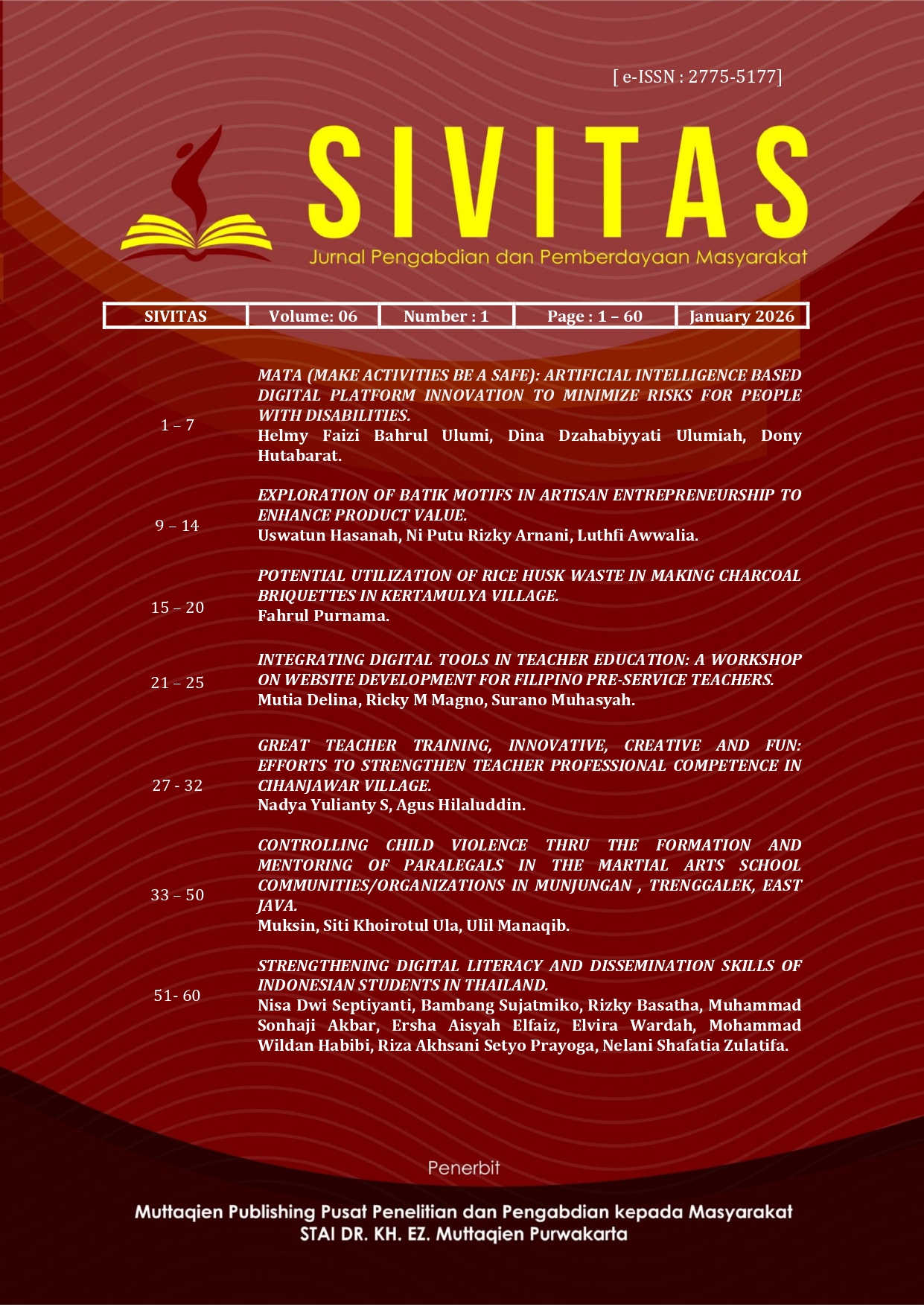
CONTROLLING CHILD VIOLENCE THRU FORMATION AND MENTORING OF PARALEGALS IN MARTIAL ARTS SCHOOL COMMUNITIES IN TRENGGALEK
Keywords:
Child Violence, Paralegal, Community / Martial Arts OrganisationAbstract
Trenggalek Regency and especially Munjungan Sub-district have experienced a decrease in conflicts between martial arts schools, but several conflicts still occur that originate from the motive of disputes between martial arts schools. These conflicts often involve children and teenagers who are supposed to be the productive next generation. At the same time, administrators of martial arts colleges who have previously been accustomed to dealing with or carrying out assistance practices when their members are in conflict, have actually also performed tasks that are close to the duties and functions of a paralegal. Therefore, it is important to carry out community service activities that are empowering in this area. The purpose of this community service activity is the formation of paralegals in the community or martial arts college organisation to control child abuse and legal advocacy to the community. The method used is the Asset-Based Community Development (ABCD) method. The results of this activity reported that: as an initial condition, the paralegal formation participants have great potential but still have limitations in terms of understanding the law, conflict mediation and child protection. Using an Asset-Based Community Development (ABCD) approach involving asset identification, participatory planning, and intensive training throughout the programme, paralegals were involved in community education activities, such as anti-violence in the internal community. This process was inclusive. The training was designed to not only increase individual capacity but also build synergy between groups in peacefully handling conflicts. The conclusion of this activity provided significant development in paralegal capacity and positive impact in the community. Paralegals who were trained have followed up and started to intensify in advocacy and mentoring.
References
Ariana Suryorini and Bambang Sumardjoko. (2020). Pemberdayaan Masjid Sebagai Fungsi Sosial Dan Ekonomi Bagi Jamaah Pemegang Saham Unit Usaha Bersama. Dimas: Jurnal Pemikiran Agama untuk Pemberdayaan. 19(2), 12-25.
Christian Blickem et al. (2018).What Is Asset-Based Community Development and How Might It Improve the Health of People With Long-Term Conditions? A Realist Synthesis,” SAGE Open 8 (2), 2. https://doi.org/10.1177/2158244018787223.
Munawar Noor. (2011). Pemberdayaan Masyarakat. CIVIS 1(2), 17-28.
Neo Adhi Kurniawan. (2020). Peran Paralegal dalam Perlindungan Serta Pemenuhan Hak Hukum Masyarakat. Jurnal Praksis dan Dedikasi (JPDS), 3(1), 28-33.
Ni Kadek Candra Dewi, dkk. (2022). Pemberdayaan Paralegal dalam Mencegah Kekerasan Terhadap Perempuan di Desa Tuwed Kecamatan Melaya Kabupaten Jembrana. Jurnal Interpretasi Hukum. 1(2), 30-42.
Qori Rizqiah H Kalingga. (2020). Program Pendampingan (Paralegal) dalam Memberikan Perlindungan Hukum Terhadap Korban Kekerasan dalam Rumah Tangga di Kecamatan Percut Sei Tuan. Jurnal Penelitian Pendidikan Sosial Humaniora. 3(1), 21-30.
Rina Nurmala.(2021). Pemberdayaan Remaja Melalui Kajian Milenial (KAMI) di Kampung Cigintung Desa Legokhuni. Sivitas. 1(1), 10-16.
Roni Ekha Putra.(2007). Analisis Terhadap Program-Program Penanggulangan Kemiskinan Dan Pemberdayaan Masyarakat Di Indonesia. Jurnal Demokrasi 6(1), 20-32.
Sri Warjiyati. (2018). Pemberdayaan Paralegal Aisyiyah Ranting Sukodono dalam Pendampingan Korban Kekerasan Perempuan dan Anak. Jurnal UIN Walisongo. 3(2), 11-19.
Afandi, Agus. (2014). Modul Participatory Action Research. Surabaya : LPPM UIN Sunan Ampel.
BPS Kabupaten Trenggalek. (2021). Kabupaten Trenggalek dalam Angka. Trenggalek : BPS Kabupaten Trenggalek.
Setyawan, Wawan Herry. (2022). Pendahuluan Apa Itu Metod ABCD,” in Asset Based Community Development (ABCD), ed. Wawan Herry Setyawan. Samarinda: PT. Gaptek Media Pustaka.
Muttaqin, Adhar. (2024). 4 Pesilat di Trenggalek Jadi Tersangka Penganiayaan Anak
Baca artikel detikjatim, "4 Pesilat di Trenggalek Jadi Tersangka Penganiayaan Anak" selengkapnya https://www.detik.com/jatim/hukum-dan-kriminal/d-7262219/4-pesilat-di-trenggalek-jadi-tersangka-penganiayaan-anak.
Polres Trenggalek. (2024Sejumlah Perguruan Martial arts dan Elemen Masyarakatterima Penghargaan Kapolres). https://pojokkidul.com/2023/12/21/sejumlah-perguruan-pencak-silat-dan-elemen-masyarakatterima-penghargaan-kapolres/
Transform, “Asset Based Community Development (ABCD),” The Transnational Partnership on Integrated Community Care, 2021, hlm. 1-2, https://transform-integratedcommunitycare.com/wp- content/uploads/2021/07/ABCD-paper_v03C.pdf.
Prima A. S., (2021) Kabupaten Trenggalek Juga Punya Banyak Pendekar dan Sisi Gelap Ini Pernah Ada (https://mojok.co/terminal/kabupaten-trenggalek-juga-punya-banyak-pendekar-dan-sisi-gelap-ini-pernah-ada/).
Published
How to Cite
Issue
Section
Copyright (c) 2026 Siti Khoirotul Ula Ula

This work is licensed under a Creative Commons Attribution-ShareAlike 4.0 International License.
SIVITAS: Jurnal Pengabdian dan Pemberdayaan Masyarakat allow the author(s) to hold the copyright without restrictions and allow the author(s) to retain publishing rights without restrictions and authors who publish with this journal agree to the following terms:
In developing strategy and setting priorities, SIVITAS: Jurnal Pengabdian dan Pemberdayaan Masyarakat recognize that free access is better than priced access, libre access is better than free access, and libre under CC-BY-SA or the equivalent is better than libre under more restrictive open licenses. We should achieve what we can when we can. We should not delay achieving free in order to achieve libre, and we should not stop with free when we can achieve libre.
SIVITAS: Jurnal Pengabdian dan Pemberdayaan Masyarakat has a CC-BY SA license or its equivalent as the optimal license for publication, distribution, use and reuse of scientific work. This license is under a Creative Commons Attribution 4.0 International License.

You are free to:
- Share — copy and redistribute the material in any medium or format
- Adapt — remix, transform, and build upon the material for any purpose, even commercially.
- The licensor cannot revoke these freedoms as long as you follow the license terms.