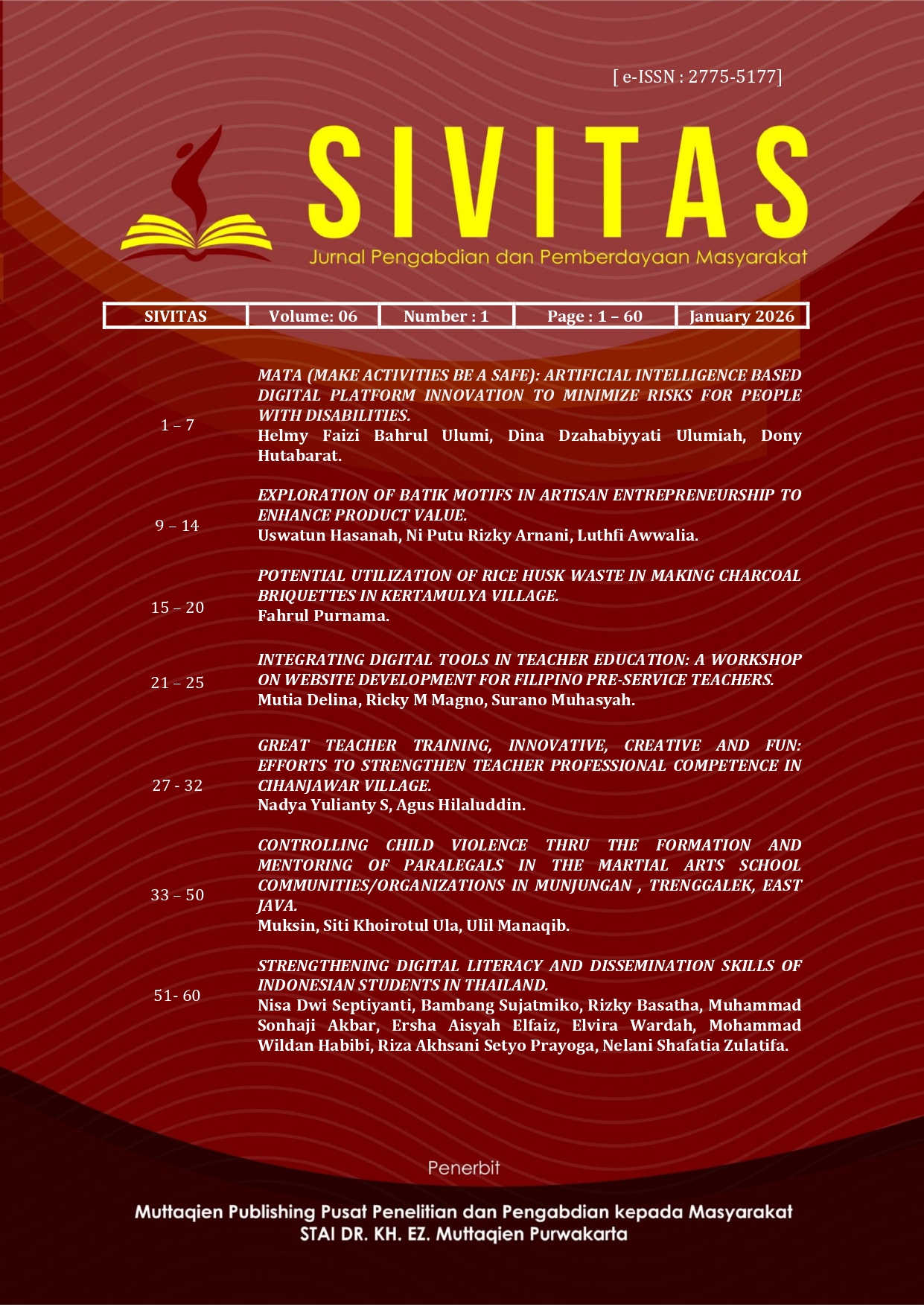
STRENGTHENING DIGITAL LITERACY AND DISSEMINATION SKILLS OF INDONESIAN STUDENTS IN THAILAND
Keywords:
information literacy, digital dissemination, media ethics, academic communityAbstract
This community service program aimed to strengthen digital literacy and enhance effective information dissemination skills among Indonesian students in Thailand. The program was an implementation of the Tri Dharma Perguruan Tinggi by lecturers from the Information Technology Education Study Program, Universitas Negeri Surabaya. The results of the activity showed that the participants, Indonesian students in Thailand, already possessed a good level of digital literacy. Through this program, they gained a deeper understanding of the importance of applying digital literacy critically, ethically, and collaboratively, as well as realizing their strategic role as information bridges between the academic community abroad and society in Indonesia. Participants also demonstrated a strong commitment to acting as credible and integrity-driven agents of knowledge dissemination. The activity concluded with a reflection session, a group photo, and the signing of a Memorandum of Agreement (MoA) between Universitas Negeri Surabaya and the Indonesian Students Association in Thailand as a form of commitment to sustainable collaboration. Overall, this program made a tangible contribution to strengthening the culture of digital literacy, building cross-national academic networks, and reinforcing the role of Indonesian students abroad as responsible ambassadors of knowledge.
References
Bilan, Y., Oliinyk, O., Mishchuk, H., & Skare, M. (2023). Impact of information and communications technology on the development and use of knowledge. Technological Forecasting and Social Change, 191. https://doi.org/10.1016/j.techfore.2023.122519
Bolong, J., & Ahmad Ghazali, A. H. (2023). A Conceptual Perspective on Natural Disasters Related Information Verification Behaviors among Youth on Social Media. International Journal of Academic Research in Business and Social Sciences, 13(17). https://doi.org/10.6007/ijarbss/v13-i17/19831
Engel, E., Gell, S., Heiss, R., & Karsay, K. (2024). Social media influencers and adolescents’ health: A scoping review of the research field. Social Science and Medicine, 340. https://doi.org/10.1016/j.socscimed.2023.116387
Isnaini, I., Nasyiriyah, T. N., Aulia Istighfari, N., & Rohmah, S. R. (2025). The Role of Digital Literacy in Social Media. Mimesis, 6(1), 58–74. https://doi.org/10.12928/mms.v6i1.12242
Karunanayaka, S. P. (2023). Knowledge co-creation in the digital age: Social Science research as a catalyst. Sri Lanka Journal of Social Sciences, 46(2), 141–143. https://doi.org/10.4038/sljss.v46i02.9112
Leiva, L. G. Q. (2025). Impact of information and communication technologies on everyday life. Management (Montevideo), 3. https://doi.org/10.62486/agma2025130
Lim, M. S. C., Molenaar, A., Brennan, L., Reid, M., & McCaffrey, T. (2022). Young Adults’ Use of Different Social Media Platforms for Health Information: Insights From Web-Based Conversations. Journal of Medical Internet Research, 24(1). https://doi.org/10.2196/23656
Morgan, A., Sibson, R., & Jackson, D. (2022). Digital demand and digital deficit: conceptualising digital literacy and gauging proficiency among higher education students. Journal of Higher Education Policy and Management, 44(3), 258–275. https://doi.org/10.1080/1360080X.2022.2030275
Pérez-Escoda, A., Pedrero-Esteban, L. M., Rubio-Romero, J., & Jiménez-Narros, C. (2021). Fake news reaching young people on social networks: Distrust challenging media literacy. Publications, 9(2). https://doi.org/10.3390/publications9020024
Salimi, G., Roodsaz, A., Mohammadi, M., Keshavarzi, F., Mousavi, A., & Zainuddin, Z. (2025). How students’ digital literacy promotes knowledge sharing and academic performance in online learning environments. International Journal of Information and Learning Technology, 42(2), 165–184. https://doi.org/10.1108/IJILT-05-2024-0095
Sinnamon, L., Dodson, S., Li, A., & Hina Shahid, S. (2024). Re-envisioning Search Education through a Critical Information Literacy Lens. Proceedings of the ALISE Annual Conference. https://doi.org/10.21900/j.alise.2024.1666
Vodă, A. I., Cautisanu, C., Grădinaru, C., Tănăsescu, C., & de Moraes, G. H. S. M. (2022). Exploring Digital Literacy Skills in Economics and Social Sciences and Humanities Students. Sustainability (Switzerland), 14(5). https://doi.org/10.3390/su14052483
Zwilling, M., Klien, G., Lesjak, D., Wiechetek, Ł., Cetin, F., & Basim, H. N. (2022). Cyber Security Awareness, Knowledge and Behavior: A Comparative Study. Journal of Computer Information Systems, 62(1), 82–97. https://doi.org/10.1080/08874417.2020.1712269
Published
How to Cite
Issue
Section
Copyright (c) 2026 Nisa Dwi Septiyanti, Bambang Sujatmiko, Rizky Basatha, Muhammad Sonhaji Akbar, Ersha Aisyah Elfaiz, Elvira Wardah, Mohammad Wildan Habibi, Riza Akhsani Setyo Prayoga, Nelani Shafatia Zulatifa

This work is licensed under a Creative Commons Attribution-ShareAlike 4.0 International License.
SIVITAS: Jurnal Pengabdian dan Pemberdayaan Masyarakat allow the author(s) to hold the copyright without restrictions and allow the author(s) to retain publishing rights without restrictions and authors who publish with this journal agree to the following terms:
In developing strategy and setting priorities, SIVITAS: Jurnal Pengabdian dan Pemberdayaan Masyarakat recognize that free access is better than priced access, libre access is better than free access, and libre under CC-BY-SA or the equivalent is better than libre under more restrictive open licenses. We should achieve what we can when we can. We should not delay achieving free in order to achieve libre, and we should not stop with free when we can achieve libre.
SIVITAS: Jurnal Pengabdian dan Pemberdayaan Masyarakat has a CC-BY SA license or its equivalent as the optimal license for publication, distribution, use and reuse of scientific work. This license is under a Creative Commons Attribution 4.0 International License.

You are free to:
- Share — copy and redistribute the material in any medium or format
- Adapt — remix, transform, and build upon the material for any purpose, even commercially.
- The licensor cannot revoke these freedoms as long as you follow the license terms.