
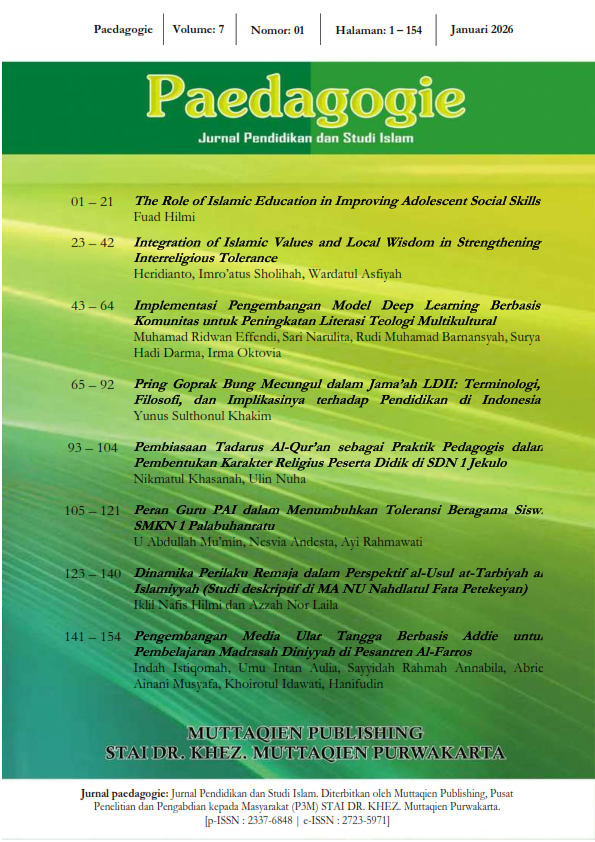
Integration of Islamic Values and Local Wisdom in Strengthening Interreligious Tolerance
Keywords:
Family, islamic values, local wisdom, religious moderation, toleranceAbstract
This research aims to analyze the integration of Islamic values and local wisdom in shaping the practice of tolerance between religions at the family and community levels. Studies of religious moderation in Indonesia have so far emphasized the role of the state and formal institutions, while the practice of tolerance that grows naturally in the family and local culture is still relatively understudied. This research is located in Gunung Malang Village, Sumberjambe District, Jember Regency, a multicultural village known for having a harmonious social life without open religious conflicts. The research uses a qualitative approach with a case study design. The data was collected through in-depth interviews with 12 informants consisting of religious leaders, traditional leaders, village officials, and interfaith families. Participatory observation was carried out for four months to capture the daily social practices of the community. Data analysis was carried out thematically using the help of NVivo 12 software until it reached the data saturation point. The results of the study show that there are three main patterns of tolerance, namely: (1) Negotiation of religious values in interfaith families, (2) Interfaith social participation in life cycle events such as marriage and death, and (3) Social solidarity based on mutual cooperation. This pattern reflects the integration of Islamic values such as rahmah, justice and ukhuwah insaniyah with local wisdom in the form of kinship systems and village deliberations. This research contributes to formulating a model of tolerance based on family and local culture as a contextual and sustainable form of religious moderation.
References
Afriansyah, A., & Sukmayadi, T. (2022). The Value of Local Wisdom of the Sea Alms Tradition in Increasing the Spirit of Mutual Cooperation of the Coastal Community of Pelabuhan Ratu Beach. Journal of Social Sciences Research, 3 (1), 38–54. https://doi.org/10.23917/sosial.v3i1.549
Ainiyah, A. S. (2023). Internalization of Multicultural Values to Increase Religious Tolerance in State Junior High School 1 Siliragung Banyuwangi. Thesis, KH Achmad Siddiq Jember University.
Alim, A. (2025). The Concept of Al-Mujtama' Al-Islami in the Qur'an. Pendas: Scientific Journal of Elementary Education, 10(02), 211–230.
Ambarwati, D., Santoso, K., & Hakim, D. M. (2025). Internalization of Islamic Religious Education Values in Improving the Relegial Character of Students at SMPN 9 Malang. Vicratina: Religious Scientific Journal, 10 (3).
Andanasari, F. D., Yuliatin, H., & Dahlan, H. (2022). The Role of Community Leaders in Fostering Tolerance Between Religious Communities (Study in Karang Baru Village, Mataram City). Journal of Civics & Social Studies, 5(2), 233–242. https://doi.org/10.31980/civicos.v5i2.1344
Arifin, B., & Huda, H. (2024). Religious Moderation as an Approach in Indonesian Islamic Education. Tarlim: Journal of Islamic Religious Education, 7(2), 143–154. https://doi.org/10.32528/tarlim.v7i2.2464
Creswell, J. W., & Poth, C. N. (2016). Qualitative inquiry and research design: Choosing among five approaches. Wise publications.
Denzin, N. K. (2005). The Sage handbook of qualitative research. Sage publications..
Denzin, N. K. (2017). The research act: A theoretical introduction to sociological methods. Routledge.
Dzofir, M., & M. Nur, D. M. (2024). Integration of Religious Moderation Values in Education at Islamic Boarding Schools: Building a Tolerant and Islamic Generation. Education: Journal of Islamic Education Research, 19(2), 347. https://doi.org/10.21043/edukasia.v19i2.30681
Efendi, S. (2018). The Role of Islamic Education in Shaping Indonesian People with Character and Personality. Azkiya, 1(1), 66–78. https://doi.org/10.53640/azkiya.v1i1.468
Endayani, H. (2023). Educational model based on local wisdom. PEMA, 3(1), 25–32.
Fithriyah, I., Afandi, A., & Hasanah, I. (2021). Religious Character Education Model Based On Local Wisdom In The Era Of Disruption 4.0 At MTs Baiturrahmah Pamekasan. Journal of Islamic Education and Management, 10(2), 2057–2073.
Hyundai, F., Sari, M., & Isamuddin, N. F. A. B. N. (2022). Religious Moderation in the Perspective of the Ministry of Religion of the Republic of Indonesia: Concept and Implementation. Al-Wasatiyah: Journal of Religious Moderation, 1(1), 66–83.
Hamdi, S., & Awalia, H. (2023). Ulumuddin : Journal of Islamic Sciences. 13, 343–360.
Haqqullah, M. W., & Harisah, H. (2025a). Religious Moderation Villages and Interreligious Tolerance: Implementation, Successes, and Challenges in Pamekasan, Indonesia. Journal of Indonesian Sociology of Religion (JSAI), 6(1), 16–28. https://doi.org/10.22373/jsai.v6i1.6461
Haqqullah, M. W., & Harisah, H. (2025b). Religious Moderation Villages and Interreligious Tolerance: Implementation, Successes, and Challenges in Pamekasan, Indonesia. Journal of Indonesian Sociology of Religion (JSAI), 6(1), 16–28.
Hariyanti, H. (2024). Expression of Tolerance in the Religious-Multicultural Society of Jayapura, Siak Regency. Journal of Religious and Social Studies, 20(1), 59–66.
Himam, M. M. (2018). Christian mission in post-independence Indonesia.
Holilah, M. (2016). Ecological Wisdom of Local Culture of the Indigenous People of Cigugur as a Source of Social Studies Learning. Journal of Social Science Education, 24(2), 163. https://doi.org/10.17509/jpis.v24i2.1453
Scientific, J., Multidisciplinary, M., & Asymp, N. (2025). Creative Commons Attribution-ShareAlike 4.0 International License. Published by Fanshur Institute: Research and Knowledge Sharing in Aceh | Sec. 78. 2(1), 78–92.
Isnaini, I., & Aniati, A. (2024a). Grassroots Initiative for Religious Moderation: Overcoming Radicalism in Rural. Nusantara Islamic Journal, 8(1), 115. https://doi.org/10.33852/jurnalnu.v8i1.554
Isnaini, I., & Aniati, A. (2024b). Grassroots Initiative for Religious Moderation: Overcoming Radicalism in Rural. Journal of Islam Nusantara, 8(1), 115–130.
Koentjaraningrat, K. (2009). Introduction to anthropology, revised edition of PT. Rineka Cipta: Jakarta.
Koentjaraningrat, P. I. A., & Development M. (2009). Ces. 9; Jakarta: PT. Rineka Cipta.
Kono, K., Fil, S., Sos, M., Suni, M., Ip, S., & Sos, M. (n.d.). Journal of the Political Axis ISSN : 2528 - 0953 Social Capital and Regional Development Based on Local Wisdom ISSN : 2528 - 0953. 44–51.
Quantitative, P. P. (2016). Qualitative quantitative research methods and R&D. Alfabeta, Bandung.
Kurniawan, J. A. (2020). Law, Islamic Fundamentalism, and Advancing Diversities in a Muslim Majority Country. A Lesson from Indonesia.
Lubis, D. L. A., Nissa, L. C., Sitinjak, A. W., Napitupulu, G. N., & Siallaan, L. (2025). The Role of the Toba Batak Language in the Preservation of Traditional Knowledge. PESHUM: Journal of Education, Social and Humanities, 4(4), 5459–5465.
Miles, M. B., Huberman, A. M., & Saldana, J. (2014). Qualitative data analysis: A methods sourcebook. (No Title).
Moleong, L. J., & Surjaman, T. (2014). Qualitative research methodology.
Mukzizatin, S., Umar, N., & Saihu, M. (2025). An Inclusive Approach to Islamic Da'wah in Citizenship Education from the Perspective of the Qur'an. Global Journal of Science, 2(9), 539–550. https://doi.org/10.55324/jgi.v2i9.230
Musbikin, I. (2021). Character education tolerance. Nusamedia.
Nasir, R. M., & Arisandy, D. P. (2022). Religious Tolerance Perspective of Surah Al-Kafirun Students in Langsa City. Al Muhafidz: Journal of Qur'an and Tafsir, 2(1), 28–38.
Neonbasu, G., Lake, R. C., German, P., Morakinyo, K. O., & Ilesanmi, O. S. (2024). Architecture in Anthropological Perspective: Structural Reflection on Local Architectural Dynamics. Local Wisdom : Scientific Journal of Local Wisdom Studies, 16(1), 18–28. https://doi.org/10.26905/lw.v16i1.10868
Nurlaili, Millah, C. U., & Nasution, E. M. (2024). Religious Moderation in Indonesia: Basic Concepts and Its Influences. Moderation: Journal of Religious Harmony, 1(1), 9–14.
Patton, M. Q. (2015). Qualitative research & evaluation methods: Integrating theory and practice. (No Title).
Pitaloka, D. L., Dimyati, D., & Purwanta, E. (2021). The role of teachers in instilling the value of tolerance in early childhood in Indonesia. Journal of Early Childhood Education, 5(2), 1696–1705.
Personal, I. (2023). Fostering Religious Tolerance in Early Childhood: The Influence of Parental Role. Al-Hayat: Journal of Islamic Education, 7(1), 192. https://doi.org/10.35723/ajie.v7i1.393
Rahman, H. A. (2022). The Essence of Tawheed Knowledge Towards the Source of Eternal Life. Kaaffah Learning Center.
Ri, T. P. K. A. (2019). Religious moderation. Jakarta: The Research and Training Agency of the Ministry of Religion of the Republic of Indonesia.
Rumahuru, Y. Z., Gaspersz, A. C. W., Agama, I., & State, K. (2021). Community Based Diversity Management : Analysis of Community Activities Building Post-Conflict Social Harmony in Tual , Maluku Province , Indonesia. 33(1), 39–49.
Santoso, B. (2022). Islamic values and local wisdom in the development of halal tourism after covid 19 in Malang City. Civilization Journal of Economics and Business, 1(1), 39–51.
Saputra, A. (2023). How is Parade Sound System in Islamic View? Republic. https://islamdigest.republika.co.id/berita/s0nob1430/bagaimana-parade-sound-system-dalam-pandangan-islam?utm_source=chatgpt.com
Saraswati, A. J., Bramasta, D., & Eka, K. I. (2020). The value of social care of elementary school students. Journal of Basic Education Research (JRPD), 1(1), 1–5.
Setia, P., & Rahman, M. T. (2022). Socializing Religious Moderation and Peace in the Indonesian Landscape. Journal of Faith and Spirituality, 2(3), 333–340. https://doi.org/10.15575/jis.v2i3.17916
Setiawan, T., De Jong, E. B. P., Scheepers, P. L. H., & Sterkens, C. J. A. (2021). Support for interreligious conflict in Indonesia: Tests of theories on interethnic threat and distrust versus contact. Journal of Pacific Rim Psychology, 15. https://doi.org/10.1177/1834490921993295
Shonhaji, S. (2017). Women's involvement in realizing social harmony in the multiethnic community in Lampung. Journal of Islamic Political Aspirations, 13(1), 17–44.
Sibarani, R., & Lubis, S. (2019). Mangdung Tradition in the Traditional Wedding Ceremony of the Angkola Community. University of North Sumatra.
Stake, R. E. (1995). The art of case study research. Sage.
Sudirman, M., Mustaring, M., & Rasyid, M. H. (2025). Integration of Islamic Values and Local Wisdom: The Relevance of the Concept of Doi'Pallawa Wanua in the Formation of the Nation's Character. Journal of Social Morality, 10(2), 864–875.
Sugarda, Y. B. (2022). Multiculturalism and Tolerance. Jakarta: Gramedia Pustaka Utama.
Suprayitno, M. A., & Moefad, A. M. (2024). The Role of Integrated Islamic Education in the Formation of the Character and Social Skills of the Young Generation of Muslims in the Era of Globalization. Scientific Journal of Educational Sciences, 7(2), 1763–1770. https://doi.org/10.54371/jiip.v7i2.3658
Tabroni, I., & Mukti, S. (2022). The Role The Diniyah Takmilyah Madrasah In Developing Character Learners. Jurnal Pendidikan dan Konseling, 4(2), 501-508.
Tang, M., Syarifuddin, N., & Natsir, M. (2025). Implementation of the Multicultural Islamic Education Model as a Violence Prevention Strategy in the Environment of STAI Al-Furqan Makassar. Journal of Islamic Religious Education Studies, 1(1), 52–63.
Wibowo, A., & Gunawan. (2015). Local wisdom based character education in schools: concept, strategy, and implementation. Student Library.
Yanti, A. N. (2023). The strategy of religious education teachers in strengthening the religious moderation of students at SMA Negeri 1 Sausu. Postgraduate of Datokarama State Islamic University, Palu.
Yin, R. K. (2018). Case study research and applications (Vol. 6). Sage Thousand Oaks, CA.
Yuliastuti, M. Hum., D. A., & Pujimahanani, S. S., M. Si., C. (2021). Tolerance as Cross-Cultural Communication among Religions in Indonesia. Dynamics : Journal of Literature and Culture, 8(1). https://doi.org/10.25139/dinamika.v8i1.4030
Published
How to Cite
Issue
Section
Copyright (c) 2026 Heridianto Heridianto, Imro’atus Sholihah, Wardatul Asfiyah

This work is licensed under a Creative Commons Attribution-ShareAlike 4.0 International License.
Copyright and Licensing Policy
Paedagogie: Jurnal Pendidikan dan Studi Islam allows authors to retain the copyright of their work and to retain publishing rights. By submitting and publishing with this journal, authors agree to the following terms:
-
Copyright remains with the author(s), and they grant the journal the right of first publication. The work is published under a Creative Commons Attribution-ShareAlike 4.0 International License (CC BY-SA 4.0), which permits use, distribution, and reproduction in any medium, provided the original work is properly cited and any derivative works are distributed under the same license.
-
Authors are allowed to enter into additional non-exclusive distribution agreements (e.g., posting to institutional repositories, publishing in books), with acknowledgment of the work's initial publication in this journal.
-
Authors are encouraged to disseminate their work online (e.g., in repositories or on personal websites) before and during the submission process to increase visibility and impact.
Paedagogie: Jurnal Pendidikan dan Studi Islam supports open access and affirms that libre access with a CC BY-SA license or its equivalent is the optimal approach for scholarly communication. We prioritize free and open dissemination while encouraging the reuse and adaptation of published content under fair and equitable terms.

You are free to:
- Share — copy and redistribute the material in any medium or format
- Adapt — remix, transform, and build upon the material for any purpose, even commercially.
- The licensor cannot revoke these freedoms as long as you follow the license terms.