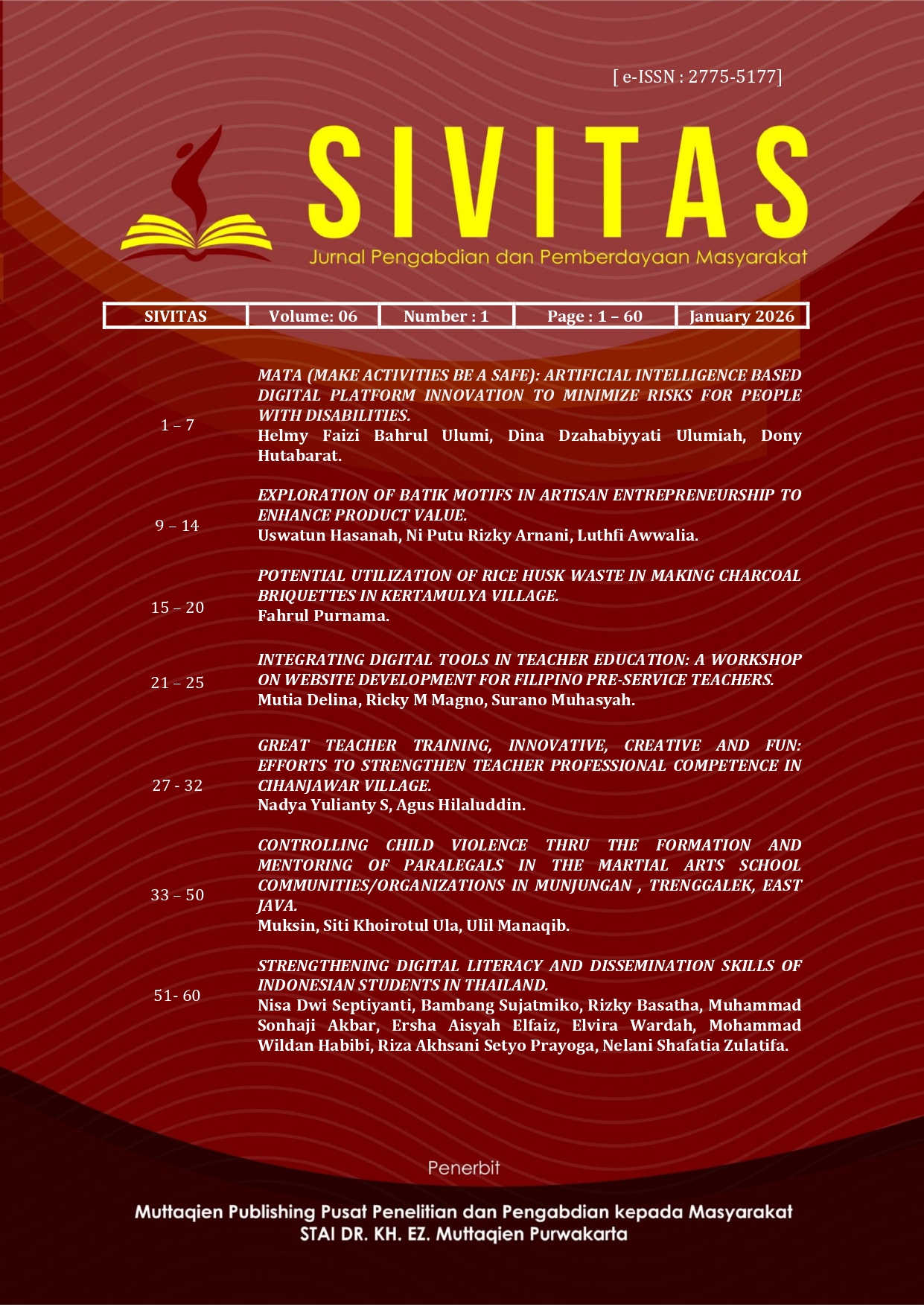
MATA (MAKE ACTIVITIES BE A SAFE): ARTIFICIAL INTELLIGENCE BASED DIGITAL PLATFORM INNOVATION TO MINIMIZE RISKS FOR PEOPLE WITH DISABILITIES
Keywords:
Artificial Intelligence, MATA Application, Visual Impairment, Assistive Technology, Inclusive EducationAbstract
The development of the MATA application (Make Activities Be A Safe) is an Artificial Intelligence (AI) based technological innovation to improve the safety and independence of the visually impaired. This service activity uses a research and development method with a design and evaluative approach. The methods used include experiments and Focus Group Discussions (FGDs). Eleven blind students and two accompanying teachers at SKHN 1 Serang City became participants. Results show that the app is effective in detecting obstacles through sound and vibration feedback, as well as increasing user confidence. Constraints include battery power and initial user adaptation. These results demonstrate the importance of policy support for inclusive technology development.
References
AHF. (2025). Peran Teknologi dalam Mempermudah Hidup Penyandang Disabilitas. Slbn Pcakra Buana. https://slbnpcakrabuana.sch.id/peran-teknologi-dalam-mempermudah-hidup-penyandang-disabilitas/
Akhmad Akhmad, Syamsiah Badruddin, Muhamad Januaripin, Salwa Salwa, V. G. (2024). INOVASI DALAM MANAJEMEN PENDIDIKAN TINGGI : Membangun Masa Depan yang Berkelanjutan. PT. Sonpedia Publishing Indonesia.
Bramasta, G. S. A. A. A. A.-I. A. P. (2024). SignSync AI : Perancangan Aplikasi Mobile untuk Membantu Mahasiswa Disabilitas dalam Melakukan Pembelajaran dengan Menerapkan AI dan AR. 8, 1052–1060.
Erissa, D., & Widinarsih, D. (2022). Akses Penyandang Disabilitas Terhadap Pekerjaan: Kajian Literatur. Jurnal Pembangunan Manusia, 3(1). https://doi.org/10.7454/jpm.v3i1.1027
Farid, L., Rahman, A., Anjarwani, E., & Irmawati, B. (2020). Rancang Bangun Sistem Informasi Bimbingan dan Konseling Berbasis Website Studi Kasus DI MTsN 1 Lombok Tengah (Design and Implementation of Counseling Information System for MTsN 1 Lombok Tengah). Jurnal Pendidikan, 4(2).
Karwanto. (2023). Optimalisasi Pemanfaatan Teknologi Pembelajaran. In 2023.
Khan, A., & Khusro, S. (2021). An insight into smartphone-based assistive solutions for visually impaired and blind people: issues, challenges and opportunities. In Universal Access in the Information Society (Vol. 20, Issue 2). https://doi.org/10.1007/s10209-020-00733-8
Nacheva, R., & Czaplewski, M. (2024). Artificial intelligence in helping people with disabilities : Opportunities and challenges ARTIFICIAL INTELLIGENCE IN HELPING PEOPLE WITH DISABILITIES : OPPORTUNITIES AND CHALLENGES. June.
PERMENSOS. (2024). Perubahan Kedua atas Peraturan Menteri Sosial Nomor 7 Tahun 2021 tentang Asistensi Rehabilitasi Sosial. Berita Negara Republik Indonesia (BN 2024).
Poerwanti, S. D., Makmun, S., & Dewantara, A. D. (2024). Jalan Panjang Menuju Inklusi Digital bagi Penyandang Disabilitas di Indonesia. Journal of Urban Sociology, 1(1), 44. https://doi.org/10.30742/jus.v1i1.3536
Rabbani, D. A., & Najicha, F. U. (2023). Pengaruh Perkembangan Teknologi terhadap Kehidupan dan Interaksi Sosial Masyarakat Indonesia. Researchgate.Net, November, 0–13. https://www.researchgate.net/profile/Dana-Rabbani/publication/375525102_Pengaruh_Perkembangan_Teknologi_terhadap_Kehidupan_dan_Interaksi_Sosial_Masyarakat_Indonesia/links/654dcc8dce88b87031d8db65/Pengaruh-Perkembangan-Teknologi-terhadap-Kehidupan-dan-Inte
Rika Widianita, D. (2023). Empati Sebagai Solusi Diskriminatif Terhadap Kaum Disabilitas Perspektif Tafsir Al-Misbah. AT-TAWASSUTH: Jurnal Ekonomi Islam, VIII(I), 1–19.
Sholihah, I., Amin, K., Muhammadiyah, U., Timur, K., Sarmila, L. J., Muhammadiyah, U., Timur, K., Dziqie, M., Al, A., Muhammadiyah, U., & Timur, K. (2016). Kebijakan Baru: Jaminan Pemenuhan Hak Bagi Penyandang Disabilitas. Sosio Informa, 2(2), 166–184. https://doi.org/10.33007/inf.v2i2.256
Singh, R., & Treleaven, P. (2024). Intelligent Systems for GIS. University College London, Department of Computer Science.
Supanji, T. H. (2023). Pemerintah Penuhi Hak Penyandang Disabilitas di Indonesia. KEMENKO PMK. https://www.kemenkopmk.go.id/pemerintah-penuhi-hak-penyandang-disabilitas-di-indonesia
Thohari, S. (2014). Pandangan Disabilitas dan Aksesibilitas Fasilitas Publik bagi Penyandang Disabilitas di Kota Malang. IJDS Indonesian Journal of Disability Studies, 1(1), 27–37. https://doi.org/10.21776/ub.ijds.2014.01.01.04
Ummah, M. S. (2019). Implikasi Artificial Intelligence Terhadap Pelayanan Bantuan Hukum Bagi Penyandang Disabilitas. Sustainability (Switzerland), 11(1), 1–14. http://scioteca.caf.com/bitstream/handle/123456789/1091/RED2017-Eng-8ene.pdf?sequence=12&isAllowed=y%0Ahttp://dx.doi.org/10.1016/j.regsciurbeco.2008.06.005%0Ahttps://www.researchgate.net/publication/305320484_SISTEM_PEMBETUNGAN_TERPUSAT_STRATEGI_MELESTARI
Uthpah, N., Mulyana, E. H., & Sumardi, S. (2021). Studi Kasus Keterampilan Sosial Anak Usia Dini dari Orang Tua Tunanetra. Jurnal Pendidikan Anak, 10(2), 104–110. https://doi.org/10.21831/jpa.v10i2.40919
Published
How to Cite
Issue
Section
Copyright (c) 2026 Dina Dzahabiyyati Ulumiah, Helmi Fauzy Bahrul Ulumi, Dony Hutabarat

This work is licensed under a Creative Commons Attribution-ShareAlike 4.0 International License.
SIVITAS: Jurnal Pengabdian dan Pemberdayaan Masyarakat allow the author(s) to hold the copyright without restrictions and allow the author(s) to retain publishing rights without restrictions and authors who publish with this journal agree to the following terms:
In developing strategy and setting priorities, SIVITAS: Jurnal Pengabdian dan Pemberdayaan Masyarakat recognize that free access is better than priced access, libre access is better than free access, and libre under CC-BY-SA or the equivalent is better than libre under more restrictive open licenses. We should achieve what we can when we can. We should not delay achieving free in order to achieve libre, and we should not stop with free when we can achieve libre.
SIVITAS: Jurnal Pengabdian dan Pemberdayaan Masyarakat has a CC-BY SA license or its equivalent as the optimal license for publication, distribution, use and reuse of scientific work. This license is under a Creative Commons Attribution 4.0 International License.

You are free to:
- Share — copy and redistribute the material in any medium or format
- Adapt — remix, transform, and build upon the material for any purpose, even commercially.
- The licensor cannot revoke these freedoms as long as you follow the license terms.